A designer's dream can be a programmer's nightmare
The Finnish Immigration Service will launch its redesigned e-service this spring. In autumn 2014 and spring 2015, we have published articles about the process of redesigning the e-service. The third article in the series looks at how the new service is built.
Anrijs Vītoliņš, a software developer from Riga, has caused jealousy among his colleagues this spring.
“I’ve had the opportunity to work with technologies based on, for example, HTML5, MVC, Bootstrap and ORM.”
If you are unfamiliar with information technology, it is like getting to drive the latest car while others drive at least a year-old model.
Building the service requires fluency in C#
Vītoliņš is a part of the new e-service team in Riga. The team of five software developers is doing its best to realise the ambitions of the visual designers working in Helsinki.
“Many features may seem simple, but are technically very challenging, such as drawing a red X over a text to mark that the text is invalid. You only need two strokes of a red pen to do this on paper, but on a website it is a software developer’s nightmare. First you need to arrange the text, then create the X and, finally, make the X partially transparent.”
At the beginning of the development, the experts from Fjord kept close contact with the software developers in Riga. The designers shared their creative vision, and the specialists in software development explained what is technically feasible.
According to Vītoliņš, the Riga team consists of multilingual interpreters who translate the wishes of the other e-service designers into a computer language.
“We are polyglots, but most often we use C# and some HTML.”
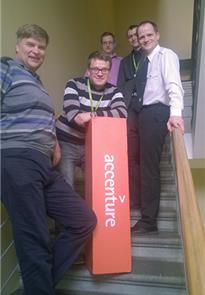
The Riga team: Anrijs Vītoliņš, Vadims Kovalovs, Andrijs Jurka, and in the background Valdis Logins and Sandijs Liepins. |
Many cooks in the kitchen – the best possible resultThe experts on the contents, i.e. the specialists in permit matters at the Finnish Immigration Service, also have their fingers in the pie. They make sure that the texts in the service are correct and presented to the customer in the right places. Andris Jurka, a colleague of Vītoliņš’s, is currently going through the new forms of the service. “My job is to transfer the paper forms into the e-service. I consider how they should look and how they work best,” Jurka explains. Designing the new service has been something of a multi-talent workshop. Every expert has learned from the work of the other experts. The software developers now have an idea of the more detailed residence permit matters, and the experts at the Finnish Immigration Service have learned what it takes to build a service like this as far as technology is concerned. |
The cooperation between Riga and Helsinki is most often fostered through online meetings.
“Nowadays it makes no difference whether you are physically in the same room or taking part through a screen,” says Vītoliņš.
Having regular contact is the most important aspect in a project with many participants. Daily meetings are held every morning to know how the work is progressing and who is doing what. When bigger decisions are to be made, the whole team comes together either in Helsinki or in Riga.
The new service is designed for all platforms
The new e-service will soon be ready. However, the exact publication date is yet unknown, as the team in Riga points out.
“One of the biggest difficulties in a project like this is to estimate how long it will take to complete the work. People seem to be innately optimistic, but then the reality strikes and slows things down. If one must choose between following a detailed plan and experimenting with new technology, the latter always comes first,” Vītoliņš says.
Despite the details that remain unclear, it is certain that everyone will be satisfied with the result.
“The most significant change from the end-user perspective is the new design of the e-service. Its usability is also improved, because it is designed to be a comprehensible service that guides the customer along the way. It is also noteworthy that the service is designed to work on all platforms. In the future, it will be possible to fill in the forms using a computer, a tablet or a smart phone,” Jurka enthuses.
| Facts: What will change? |
|---|
| The Finnish Immigration Service’s and the police’s e-service for applying for residence permits will be redesigned in the spring of 2015. The service will have a new visual look and an improved structure after the launch. The aim is to create an easier and a simpler service for applying for residence permits, citizenship and EU registrations online. In addition to web design experts, also customers of the agency as well as officials who process applications have taken part in redesigning the new service. |
Previous articles:
17.12.2014 “I wish this service had existed when i applied for a residence permit”
21.10.2014 Customers assist in developing the new e-service


