Reception centres help asylum seekers to integrate into Finnish society
A reception centre provides asylum seekers not only with accommodation and food but also with information on how Finnish society works. Reception centres and asylum seekers are a hot topic in public debate in Finland today, and because of a shortage of information there are some common misconceptions about what reception centres do. We want to respond to this by telling the public what reception centres actually do in practice.
The daily routine of asylum seekers in reception centres is similar to that of many native Finns: going to work or school, recreational activities and mealtimes. Work and study activities are arranged to help asylum seekers to take initiative and eventually to lead independent lives.
Asylum seekers who repeatedly decline to take part in the work and study activities may have their reception allowance cut. In most cases, asylum seekers work as cleaners in the reception centre and attend Finnish language classes. Reception centre personnel also guide those who have the right to work in seeking employment or applying for studies.
Reception centres also provide opportunities for exercise, for instance with donated gym equipment, and activities such as cooking classes with a local club of the Martha Organisation. Nationwide football and street dance events hosted by volunteer organisations also feature in the daily routines of reception centres.
Initial briefings introduce the reception centre and possibly include requests from neighbours
Some Finns are critical of asylum seekers being allowed to move around freely in Finland even though they are not familiar with the rules of Finnish society. Actually, asylum seekers are informed about Finnish society very soon after they enter the country.
The initial briefing given to asylum seekers includes a presentation of the asylum process and of the reception centre and its rules. The briefing also covers key points in Finnish legislation and customs. The briefing may further include items requested by neighbours, such as traffic regulations or practical points such as the fact that in Finland it is not polite to walk into another person’s garden uninvited.
The Finnish Immigration Service, NGOs and reception centres have prepared information packages for asylum seekers about Finnish society, legislation, employment in Finland, sexual health, food, nutrition and how to maintain mental health. The purpose of these packages is to help asylum seekers fend for themselves and to take other people into consideration according to the rules and customs of Finnish society.
Providing such information is clearly worth it: the Finnish Immigration Service has not recorded any serious incidents between asylum seekers and the local population during the five years in which it has been managing reception centres nationwide. The Finnish Immigration Service does receive occasional reports of violence, but without exception these are arguments between asylum seekers.
“Of course, one has to expect clashes when someone from a completely different culture arrives in Finland. No one can be expected to learn the local customs instantly. Every day, the personnel at reception centres do their best to explain to asylum seekers how Finnish society works. We get a lot of help from local volunteers, NGOs and sports clubs,” says Senior Adviser Inkeri Mellanen from the Reception Unit at the Finnish Immigration Service.
Mostly ordinary social work
Reception centres with 200 beds have approximately 15 employees, and centres with 500 beds have approximately 30 employees. Most of the employees are instructors. There are also social workers, social instructors and nurses. The biggest centres also employ benefits officers, janitors and human resources secretaries. Each centre is managed by a Director, and larger centres also have Deputy Directors.
Most of the work done at reception centres is ordinary social work of the kind that is done in every municipality in Finland; the only difference is that the clientele consists of asylum seekers. Social instructors and social workers give clients guidance at one-on-one meetings, engage in supportive dialogue, manage the wellbeing of families and children, organise relocation for those who have been granted asylum, make decisions concerning applications for reception allowance, and offer guidance on employment and studies.
The job profile of the social instructors includes anything from office work to managing repairs, from preparing accommodation and supplies for new residents to organising police hearings, from transport to briefings, and generally making sure that all residents are doing well. Work at reception centres is never-ending.
Shortage of beds threatens to put people on the street
There is a huge need for new reception centres; the number of asylum seekers skyrocketed in August, and all current centres are operating beyond their capacity. People are now sleeping on the floor in close quarters, which is definitely not a long-term solution. Tents had to be erected in Turku on Tuesday.
If the number of asylum seekers remains at the current level and new reception centres are not opened soon, people may be forced to sleep on the streets. If that happened, it would become more difficult to provide reception services or to process applications quickly and the authorities would not know where to find the applicants. It would also be challenging to provide asylum seekers with information on Finnish society.
“We are appealing to municipalities: Please cooperate with us in opening new reception centres. It is ultimately in everyone’s best interest,” says Jorma Kuuluvainen, Director of the Reception Unit.
Further information for the media
- Jorma Kuuluvainen, Director, Reception Unit, tel. +358 295 430 431
- Olli Snellman, Senior Adviser, Reception Unit, tel. +358 295 430 431
- Inkeri Mellanen, Senior Adviser, Reception Unit, tel. +358 295 430 431
(E-mail addresses: firstname.surname@migri.fi)
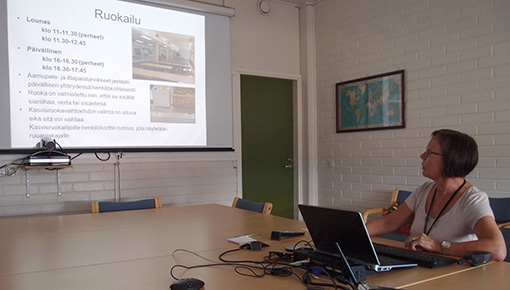
Sari Hamard is one of the instructors who provide new residents with basic information about Finland at the Joutseno reception centre. The goal is to provide this information within three days of each asylum seeker’s arrival at the centre. (Photo: Joutseno Reception Centre)


